Hospital Series on Services Part 4 Medical Laboratory
Posted on Tuesday, November 17th, 2026
Mercy Health Love County Laboratory
Returns Stronger After Tornado
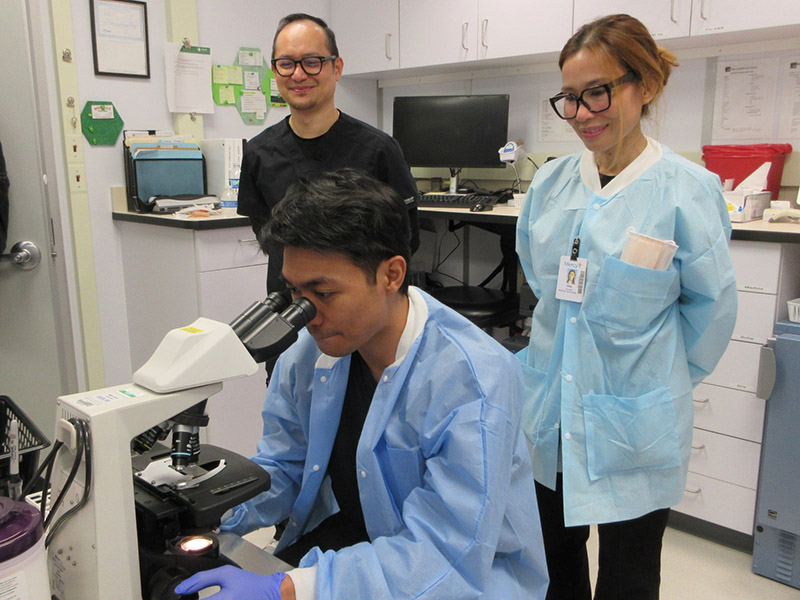
Eyes on the Result: Medical Laboratory Director John P. Galano (l) and Gay Galano, AMT, laboratory technologist, look on as Michael Sarabia, AMT, laboratory technologist, uses
a microscope.
"This is a great lab, the best lab I know of in a small hospital."
That praise came from Tony Gregory, a Siemens technical application specialist who has traveled throughout the region installing laboratory testing equipment. Gregory visited Mercy Health Love County just months before the spring 2024 tornado that destroyed the laboratory and many other hospital departments.
His admiration extended beyond the quality of testing.
"Wherever I go, I brag on this lab," Gregory said. "I tell others, 'If you want to know how to take care of your testing system, go to Love County.'"
The laboratory's reputation for excellence was built over many years. John Galano, the current Medical Laboratory Director, succeeded Kelvin McMillan, who led the department for 14 years beginning in 2008.
Under their leadership, the Mercy Health Love County laboratory consistently ranked among the top-performing rural hospitals in Oklahoma affiliated with the Mercy system. The recognition reflects the laboratory's ability to deliver accurate results for emergency patients faster than comparable facilities.
Following more than a year of recovery after the tornado, the laboratory moved into new quarters within the temporary Emergency Department on June 5, 2025. Full on-site laboratory services were restored for both patients and the community.
While laboratory staff performs a critical role in emergency care, their services extend well beyond the Emergency Room.
"The lab serves the clinic, we serve industry by performing employment testing, we serve the jail, and home health care agencies that have Love County patients," Galano said. "We also serve area patients who have doctors in Ardmore and elsewhere."
The ability to have laboratory work completed locally provides a significant convenience, especially for patients who must fast before testing or require frequent follow-up blood work.
"Our outpatient hours are 8:30 a.m. to 5 p.m., but we are flexible for patients who need us to come a little earlier or stay a little later," Galano said.
The laboratory can be reached at (580) 276-3347, ext. 4.
Advanced Technology Close to Home
The workhorse of the laboratory is the Siemens Dimension EXL 200 Integrated Chemistry System, capable of performing more than 400 laboratory tests per hour.
The highly automated analyzer processes blood and body-fluid samples through multiple testing stations. A menu of 47 different tests can be performed from a single specimen.
The system fulfills approximately 90 percent of the laboratory's testing needs.
Ironically, the sophisticated and expensive machine Gregory came to install before the tornado survived both the destruction and nearly a year in storage.
For tests that cannot be completed locally, specimens are sent to Quest Diagnostics.
"For any test we cannot do in-house, we use Quest Lab, a reference laboratory," Galano said. "Their courier picks up specimens morning and evening, and there is a four-day turnaround for results. They can expedite testing when requested."
Critical Results When Minutes Matter
The value of a local laboratory becomes particularly evident when testing produces a critical result.
A critical result indicates a patient is at immediate risk of death or serious harm unless urgent medical intervention occurs. Having testing capabilities and medical providers under the same roof can significantly shorten response times.
"Having the lab right here and the ordering doctor or nurse practitioner right here makes all the difference," Galano said.
Emergency medicine depends upon rapid laboratory confirmation of conditions such as heart attacks, severe infections, and other life-threatening illnesses.
"It takes a lot of schooling and training to respond to an emergency," Galano said. "You have to stay calm, take the steps in order and trust your training and experience."
The most common specimens tested are blood and urine. Laboratory professionals analyze chemical components such as glucose, electrolytes, enzymes, hormones, lipids, proteins, and other metabolic substances.
Abnormal findings provide valuable clues that help physicians identify disease, confirm diagnoses, or rule out suspected conditions. Laboratory data often provides the evidence needed to support or challenge a physician's initial clinical assessment.
Ensuring the accuracy of those results requires constant attention.
"We have daily, weekly and monthly testing," Galano said, referring to the quality-control procedures used to verify equipment performance and calibration.
A Profession in Demand
Galano and his staff hope local students will consider careers in laboratory science.
"There is a critical shortage of laboratory technologists, and we encourage any young people who like science to come see us and learn about pursuing this profession," he said.
According to U.S. News & World Report career rankings, medical laboratory professionals continue to be recognized among the nation's most promising healthcare careers.
Galano became licensed as a medical laboratory technologist in 2014 after earning a bachelor's degree in laboratory science from Northeastern State University in Tahlequah. He also holds a master's degree in public health.
Gay Galano, John’s wife, has worked as a laboratory technologist at Mercy Health Love County for 22 years. She holds a Bachelor of Science degree and certification through the American Medical Technologists organization.
She says she always knew laboratory science was the right career.
"It is never boring," she said. “Doctors make diagnoses with the help of the laboratory.”
Michael Sarabia joined the department in 2023 following his college graduation and also holds American Medical Technologists certification.
JoAnn Carney serves as a part-time technologist.
Together, the laboratory staff provides around-the-clock support for the Emergency Department while maintaining weekday outpatient hours.
Looking Ahead
Although the staff patiently waited for restoration of laboratory services following the tornado, they remain focused on the future.
The team has already been involved in planning laboratory space for the replacement hospital.
"It will be like Christmas the day we move into this fully furnished laboratory," Galano said.
Construction of the new Mercy Health Love County hospital remains contingent upon the awarding of rebuilding funds from the Federal Emergency Management Agency (FEMA). Until then, the laboratory continues doing what it has long done best: providing fast, accurate testing close to home for the people of Love County.
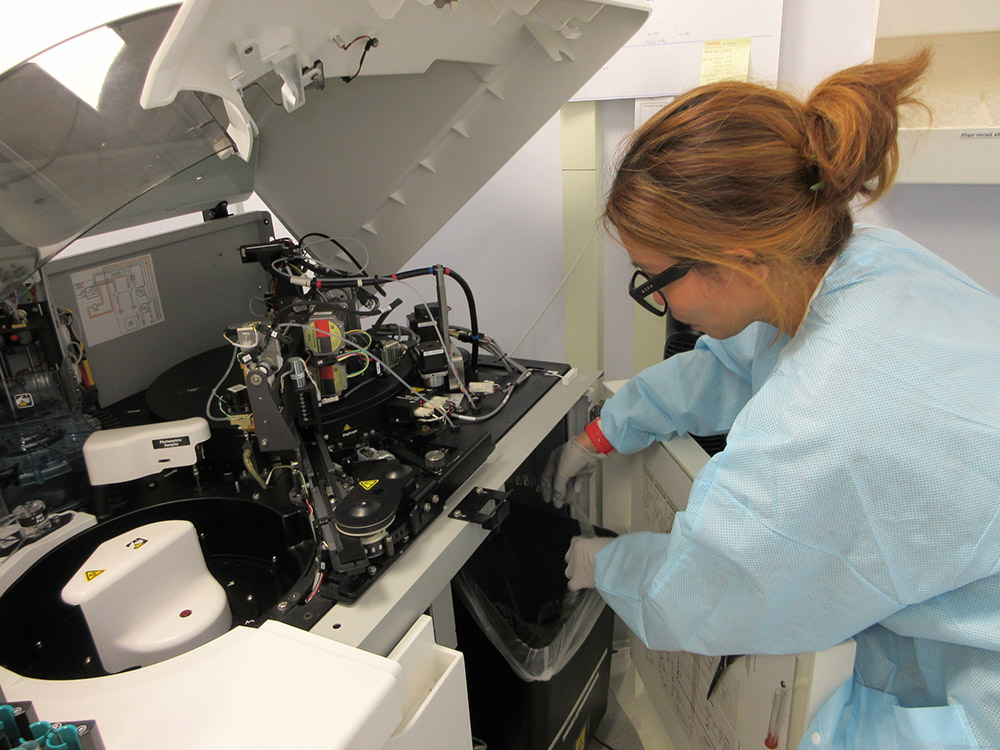
Care of the Testing Systems: Gay Galano, AMT, starts work each morning by
cleaning the major testing machine in the Mercy Health Love County
medical laboratory.